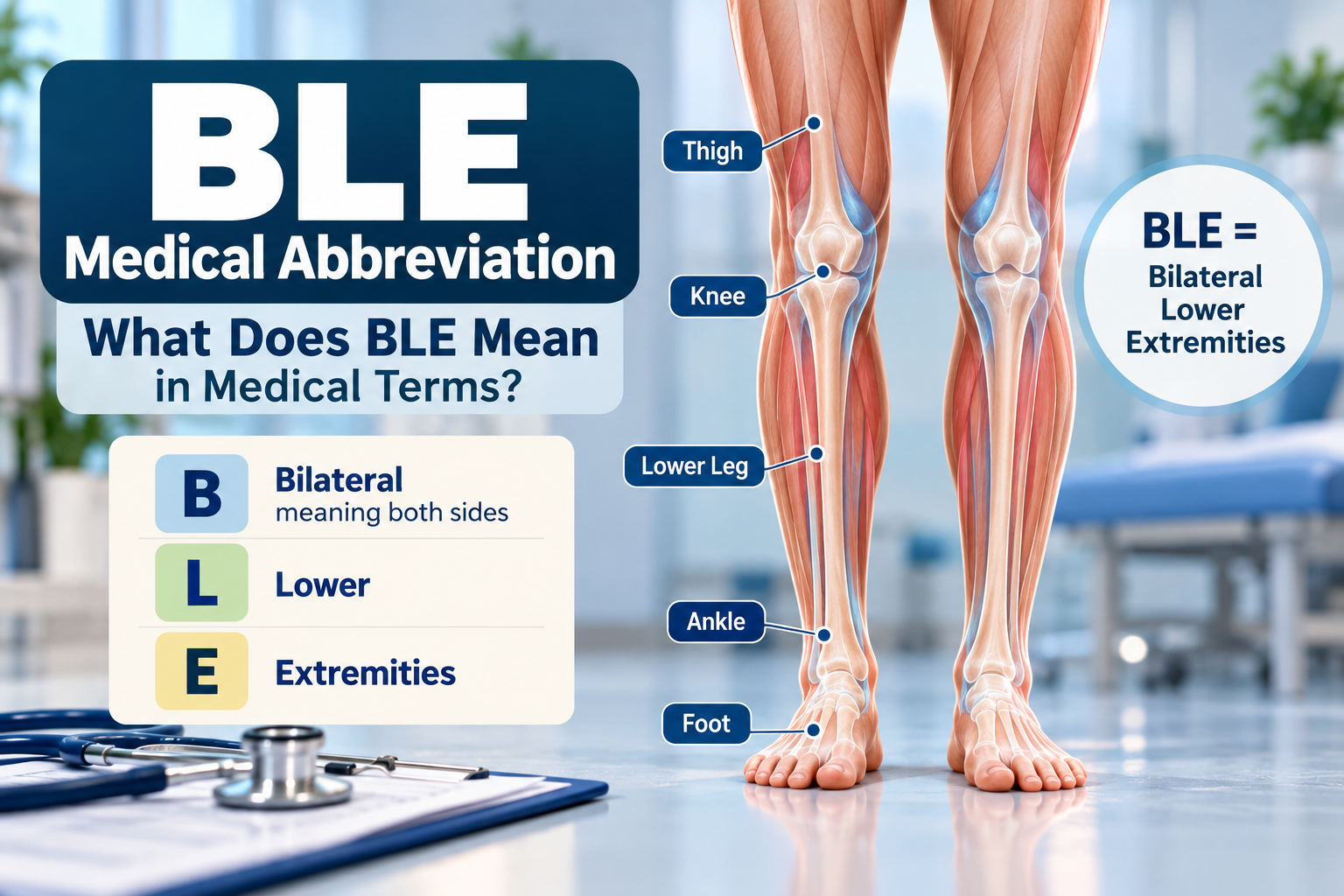
The medical term BLE is used in medical records, such as by physicians, in nurse documentation, in physical therapy records, in medical assessment reports, in hospitals, clinics, and in a doctor’s office. The U.S. Department of Health and Human Services (HHS) defines BLE in its acronym list as ‘Bilateral lower extremities.’
What Does BLE Mean in Medical Terms?
In medical terminology, BLE means bilateral lower extremities.
The term can be broken down into three parts:
- B = Bilateral, meaning both sides
- L = Lower
- E = Extremities
So BLE refers to the right lower extremity and the left lower extremity. The lower extremities are your legs and related structures. In general, clinical findings on the BLE would be noted for both lower extremities on both sides of the body, for example, pain in BLE or swelling of the BLE.
The term BLE is used frequently to document symptoms of pain, swelling, loss of sensation, decreased strength of the lower extremities.
What Does BLE Stand For?
BLE stands for bilateral lower extremities.
This is often used in clinical notes in place of writing out the full term ‘bilateral lower extremities’. For example, ‘decreased sensation in BLE’ means decreased sensation in both lower extremities and ‘strength assessed in BLE’ means that strength was assessed in both lower limbs.
For example:
“Decreased sensation in BLE”
As an example for the above phrase it would be written: “Decreased sensation in BLE”.
Similarly:
“Strength assessed in BLE”
For example: Strength assessed in BLE indicates that strength was assessed in both lower limbs.
What Are the Bilateral Lower Extremities?
“Lower extremities” is how we refer to the lower parts of the body in clinical situations, and by adding “bilateral” to this word we are indicating that both sides are involved.
Therefore:
Bilateral lower extremities = both lower limbs
Lower extremity refers to the lower part of the body. Documentation of the lower extremities includes observation or assessment of the following: the thigh, knee, lower leg of the ankle/foot, etc.
The area referred to by the phrase “lower extremities” is determined by the remainder of the medical note.
How Is BLE Used in Medical Notes?
Much like the single lower extremities BLE is used primarily to document findings that affect both lower extremities.
Some examples include:
Pain in BLE
Pain in BLE: The same documentation is used when pain is noted in both lower extremities.
Swelling in BLE
Swelling in BLE. This is used when both lower extremities have swelling noted or reported.
Edema in BLE
“Edema in BLE” would also be a method of documenting edema in both lower extremities. Again, however, the BLE itself does not indicate a cause of the edema.
Weakness in BLE
In medical literature, BLE refers to bilateral lower extremities and can be used to describe findings relating to strength or a neurological deficit in the lower extremity(s).
Sensation in BLE
Sensation in BLE – The medical note may state whether the sensation is Normal, Reduced or Absent in the BLE. The reports are usually generated by clinical teams when documenting findings involving sensory (sensory) on both lower extremities.
What Does “BLE” Mean in Nursing?
Both lower extremities may be referred to by nursing staff as BLE in documentation for lower extremities.
For example, a nursing note regarding the following observations would be documented using “BLE” as described above:
- BLE swelling
- BLE edema
- BLE pain
- BLE pulses
- BLE sensation
- BLE movement
This abbreviation indicates that both lower extremities are involved with a finding or observation.
Also, note that when BLE is used in a sentence or phrase within medical documentation, that sentence or phrase must also be reviewed to verify the exact meaning of that sentence or phrase within said documentation.
BLE in Physical Therapy
BLE is also used in physical therapy documentation.
In physical therapy documentation of case studies, we use BLE for bilateral lower extremities, e.g. comparing RLE (right lower extremity) and LLE (left lower extremity) to BLE. Typical findings that we record for both lower extremities are limitations in movement, weakness, limitations in range of motion, decreased sensation, limited mobility and decreased function.
For example:
- RLE = right lower extremity
- LLE = left lower extremity
- BLE = bilateral lower extremities
BLE vs BUE
BLE and BUE refer to different parts of the body.
| Abbreviation | Meaning |
|---|---|
| BLE | Bilateral lower extremities |
| BUE | Bilateral upper extremities |
| RLE | Right lower extremity |
| LLE | Left lower extremity |
| RUE | Right upper extremity |
| LUE | Left upper extremity |
BLE refers to both lower extremities. BUE refers to both upper extremities.
Common Medical Phrases Using BLE
You may encounter BLE in phrases such as:
- BLE pain
- BLE swelling
- BLE edema
- BLE weakness
- BLE numbness
- BLE sensation
- BLE strength
- BLE movement
- BLE pulses
- BLE assessment
This is to restate that BLE always means bilateral lower extremities. Whatever words surround BLE are simply additional documentation details.
Is BLE the Same as Both Legs?
BLE stands for both lower extremities, or both legs.
Lower extremities, as used clinically, is more than just legs. The areas covered are stated within the documentation.
What Is the Difference Between BLE and Bilateral Lower Extremity?
The phrases are closely related.
BLE = bilateral lower extremities
Bilateral lower extremity = singular form referring to one lower extremity in a bilateral context.
Bilateral lower extremities = both lower extremities
In clinical documentation, BLE is used as the abbreviation for bilateral lower extremities.


